
When this journey began, I thought I knew what I was looking for.
I wanted an answer.
More specifically, I wanted the answer.
Something that would explain how people who had been shaped by years of hurt could actually change.
How fear could loosen its grip.
How old patterns could be replaced.
How people who had learned to survive could begin learning how to live differently.
But there was something underneath that search that I don’t think I fully understood at the time.
I was desperate.
I wasn’t coming into this as someone with a strong Bible-study routine. At that point, I wasn’t consistently reading my Bible at all. I hadn’t done that in years.
But I could see things in my life that I didn’t know how to fix.
I could see the ways hurt had shaped me.
I could see problems in my relationship that couldn’t be solved simply by trying harder.
And I had reached a point where I needed to know whether things could actually be different.
Somewhere in my mind, I think I believed there had to be one missing piece.
One truth.
One breakthrough.
One key that would finally unlock everything else.
I wasn’t looking for another project.
I certainly wasn’t trying to start an intensive Bible study that would consume months of my life.
I was looking for transformation.
I needed the answer to be real.
Because I needed something in my life to actually change.
The Question Underneath Everything
The question that started this study was surprisingly simple:
How do we become who God intended us to be instead of what happened to us?
It wasn’t an abstract theological question.
It grew out of what I was seeing in my own life and relationship.
I could see how deeply wounds left by other people could shape the way we thought.
The way we reacted.
The things we feared.
The way we saw ourselves.
Even the way we saw God.
I believed there had to be something more available through Christ.
I just didn’t understand what getting from here to there actually looked like.
I wanted healing.
I wanted freedom.
I wanted transformation.
I wanted the things that had happened in the past to stop having so much influence over the present.
And even though I hadn’t been consistently reading my Bible, I was desperate enough to go looking there for answers.
At the time, I thought I might spend a couple of weeks studying the subject.
Learn what I needed to learn.
Find whatever I had been missing.
Then hopefully figure out what to do with it.
That was about as far as the plan went.
I wasn’t trying to build something. I was trying to fix something.
I had no idea those two things were about to collide.
Looking for the Master Key
One day, I opened the Bible I’ve had since I was sixteen.
As I was reading, I came across the passage about abiding in Christ and His words abiding in us.
The heading in that particular Bible called it:
“The Master Key to Prayer.”
That phrase caught my attention immediately.
A master key.
That sounded like exactly what I was looking for.
Not because I thought I had discovered some way to get whatever I wanted from God.
That wasn’t the point.
I wanted God to work more deeply in my life.
I wanted Him to heal what had been damaged.
I wanted Him to change what years of hurt had shaped.
I wanted to understand how people actually become different.
And if there really was some kind of “master key” that would help me understand how that happened, I wanted to find it.
But as I continued reading, something else caught my attention.
Identity in Christ.
At first, it didn’t seem like the answer to everything.
It was simply something I felt I needed to study.
But the question in my mind had essentially been:
What finally fixes this?
And somehow, the search was beginning to lead toward a very different question:
Who am I in Christ?
I thought I was searching for the thing that would unlock change.
Instead, I was being led toward a place to begin.
The Question Never Really Changed
Weeks later, I looked at how the study had developed and realized something.
My original question hadn’t really changed.
I was still asking:
How do we become who God intended us to be instead of what happened to us?
What had changed was where the search was leading me.
I had begun studying things like:
New creation.
Reconciliation.
Freedom.
Adoption.
Righteousness.
Renewal.
God’s work in transforming His people.
At first, they seemed like separate subjects.
Eventually, I started seeing the connection.
They were touching different parts of the same question.
What does God do with people who have been broken?
Who are His people because of what Christ has done?
What does transformation actually begin with?
The questions were becoming larger rather than smaller.
And strangely, I was becoming more comfortable with that.
Because I was beginning to realize that perhaps I hadn’t needed the kind of answer I thought I did.
I went looking for a key.
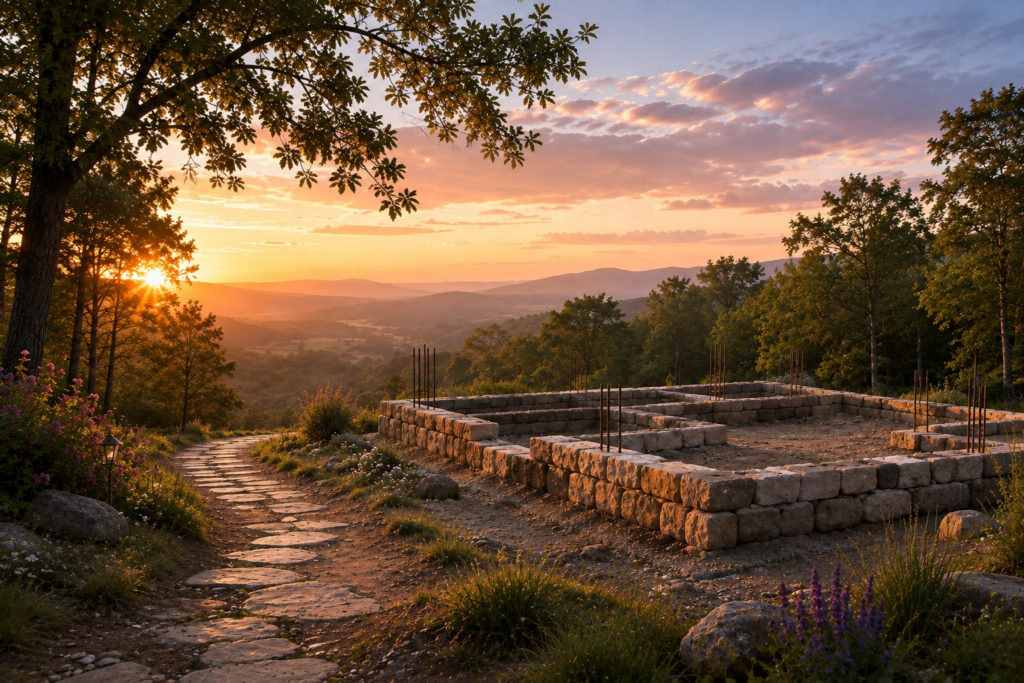
What I was beginning to recognize looked much more like a foundation.
A Foundation Instead of a Shortcut
That distinction has become increasingly important to me.
A key suggests that once I find the right thing, I can unlock the door.
A foundation works differently.
A foundation isn’t the finished building.
It doesn’t answer every question.
It doesn’t eliminate every problem.
And it certainly doesn’t mean there isn’t more work ahead.
But everything that comes afterward depends upon what is underneath it.
That’s what I began to realize this study was giving me.
Not a formula.
Not a technique.
Not a five-step solution for healing.
A place to begin.
Instead of constantly asking:
How do I fix this?
I was being drawn back to questions underneath that one.
Who is God?
What has Christ done?
Who does God say His people are in Christ?
And what does that mean for a life that has been shaped by things He never said about me?
I don’t have all of those answers yet.
I’m still working through the first passage in a much larger study.
But even this first part has already made me reconsider some of the assumptions I brought with me when I began.
I wanted something that would take me quickly to the finished result.
Instead, I found myself being drawn back to what everything else would have to rest upon.
When Old Beliefs Meet Something Stronger
My past had shaped a lot of things.
The way I viewed myself.
The way I viewed other people.
The way I responded to fear.
The things I expected from relationships.
Even some of the ways I understood God.
Opening my Bible didn’t make those things disappear.
But studying Scripture began giving me something against which those beliefs could be measured.
And sometimes they didn’t survive the comparison.
I began to see that what happened to me and who I am are not identical things.
The past is real.
Its effects can be real.
Healing can still be necessary.
But I was beginning to question whether the things that shaped me had the right to define me.
That is a much larger question than I understood when I began.
And it is one I’m still exploring.
For now, it has been enough to recognize that some of the things I had accepted as foundational might not belong in the foundation at all.
I didn’t need to pretend the past hadn’t shaped me.
I needed to begin asking what had the authority to shape what came next.
I Don’t Want to Build Faster Than the Foundation Can Hold
Recently, the foundation picture became meaningful to me in another way.
I’m nearing the end of my work on 2 Corinthians 5:17.
What I thought might be a relatively short Bible study has become months of research, reflection, word studies, commentary work, theme studies, journal entries, and eventually a twenty-six-page synthesis of one verse.
And I’ve reached a point where I could simply say:
Good enough.
Move on.
But I don’t want to do that.
Instead, I came to a realization I never expected when I began this study.
I need someone else to look at it.
I want a few trusted people to review the work before I carry the same process into the next verse.
Not because I expect them to tell me what to believe.
Not because I expect anyone else to do the work of studying Scripture for me.
And not because I think everything I’ve done has to be perfect before I continue.
I want another set of eyes on the process.
Are there gaps I haven’t noticed?
Places where I’ve moved too quickly?
Assumptions that need to be examined?
Areas that could be strengthened now rather than several verses from now?
The more I thought about it, the more the foundation analogy came back to me.
If you’re building something that may eventually carry considerably more weight, you don’t wait until several floors have been added before checking for weaknesses underneath them.
You inspect what you’re doing while you can still strengthen it.
That’s what I want to do here.
I don’t want to become so attached to the amount of work I’ve already done that I’m unwilling to hear that part of it could be better.
And I don’t want the desire to reach the next verse to become more important than making sure I’m handling this one carefully.
The goal isn’t to finish quickly.
The goal is to build carefully.
Finding Something Better Than the Answer I Wanted
I still think about that old Bible sometimes.
About seeing the words “The Master Key to Prayer” and immediately thinking:
That’s what I need.
In a strange way, I understood my need correctly.
I just misunderstood what finding the answer would look like.
I wanted something that would unlock healing.
Instead, I was led deeper into Scripture.
I wanted a breakthrough.
Instead, I was given questions that required time.
I wanted to know how to change.
Instead, I found myself asking who God says I am in Christ.
I wanted the answer.
Instead, I found where I needed to begin building.
And I think that’s an important distinction.
I’m not standing at the end of this study looking backward with everything figured out.
I’m still in it.
There are more verses ahead.
More questions.
More things I don’t understand yet.
Even the foundation I’m beginning to recognize is something I’m still learning to understand more fully.
But I’m no longer searching for a shortcut to the finished product.
I’m learning to care about what everything else will eventually stand upon.
I started this journey looking for the key.
I found where I need to build.
Now I want to build carefully.
With hope,
Raven