
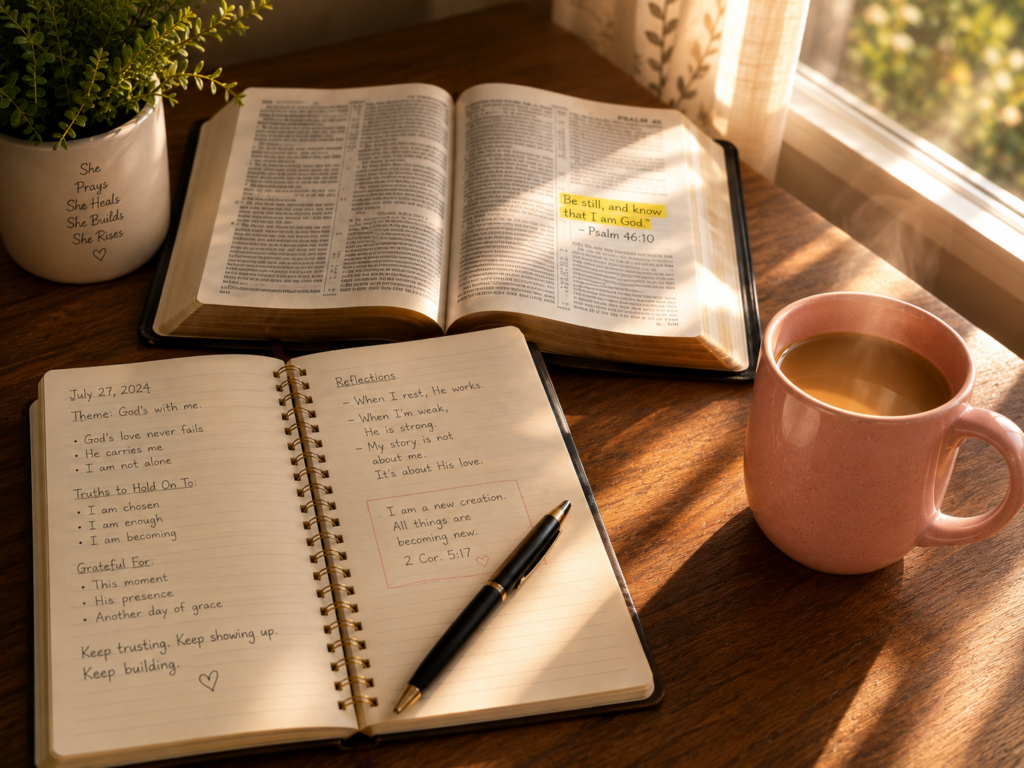
When I began studying identity in Christ, I was looking for answers.
If I’m being completely truthful, part of me probably hoped those answers would come quickly.
Find the right passage.
Understand the right truth.
Recognize what needed to change.
Then somehow begin moving forward.
Instead, I found myself entering a process.
A much slower process than I expected.
One verse became weeks of study.
Questions led to more questions.
Reading led to reflection.
And reflection required me to stop long enough to pay attention to things I might otherwise have rushed past.
Somewhere along the way, I began to realize something I hadn’t expected.
The work wasn’t getting in the way of the restoration.
The process itself was becoming part of it.
I Expected Answers. I Got a Process.
When I first opened my Bible, I thought the most important thing would be what I learned.
And what I was learning certainly mattered.
But eventually I began realizing that the way I was learning mattered too.
This study couldn’t be rushed.
I had to read.
Think.
Research.
Pray.
Come back.
Sometimes I had to admit that I didn’t know the answer yet.
And then I had to keep going without one.
For someone who had spent much of life trying to solve the next problem as quickly as possible, that was more significant than I initially realized.
There was no shortcut through this study.
I couldn’t force understanding simply because I wanted it.
I couldn’t rush through a difficult question just because sitting with it was uncomfortable.
Some things needed time.
I had begun the study because I wanted to know how things could change.
I didn’t realize the process of learning would begin changing the way I lived.
The Study Changed the Rhythm of My Days
One of the first places I could see that change was in the ordinary rhythm of my days.
I started getting up and opening my Bible before the day really began.
I spent less time mindlessly scrolling.
I prayed more.
I reflected more.
I became more comfortable leaving some questions unanswered instead of forcing myself to resolve everything immediately.
The study became somewhere I returned to consistently.
Not perfectly.
Not according to some rigid schedule.
But consistently.
And that consistency began creating a different rhythm.
Instead of constantly consuming something new, I was spending weeks with the same passage.
Instead of immediately moving on from a thought, I was writing it down and returning to it later.
Instead of assuming every question needed an immediate answer, I was learning that sometimes I could simply keep studying.
That might not sound particularly life-changing.
But for me, it was.
For a long time, so much of life had been about responding to whatever demanded my attention next.
Solve the problem.
Handle the responsibility.
Get through the day.
Move on to the next thing.
The study asked something different of me.
It asked me to keep showing up without demanding that everything be resolved immediately.
And slowly, that rhythm began following me beyond the pages of my Bible.
Learning to Slow Down
One particular day made that especially clear.
I was tired.
Not sick.
Not completely unable to function.
Just tired in a deeper way that I had learned to ignore for years.
Normally, I would have pushed through.
I would have found something productive to do.
I probably would have felt guilty for resting unless exhaustion eventually made the decision for me.
Instead, I did something surprisingly simple.
I rested.
I crawled into bed.
I drank water.
I stayed still.
And for a while, part of me wondered whether I was wasting the day.
Eventually, I realized I wasn’t wasting it.
I was listening.
That may sound like a very small change.
For me, it wasn’t.
I was beginning to recognize what I needed before reaching the point where my body or circumstances forced me to stop.
And I could see a connection between that moment and the rhythm I had been learning through the study.
I didn’t have to force everything.
I didn’t have to prove something through constant movement.
I could pay attention.
I could give something the time it actually needed.
Resting didn’t mean I had stopped moving forward.
Sometimes slowing down was part of moving forward.
Restoration Began Showing Up in Ordinary Places
The changes weren’t dramatic.
There wasn’t one morning when I woke up and suddenly felt like an entirely different person.
Most of what I noticed was much smaller.
I was praying more.
Spending more time in Scripture.
Allowing myself to hope.
Making plans again.
Engaging with people more.
Laughing more.
Taking better care of myself.
Participating in life instead of merely getting through it.
None of those things seemed extraordinary by themselves.
But together, they told a story.
Something was changing.
For years, I had become very good at surviving.
Keep going.
Handle what needed to be handled.
Solve the next problem.
Make it through another day.
But restoration didn’t always look like another problem being solved.
Sometimes it looked like laughter returning.
Sometimes it looked like wanting something again.
Sometimes it looked like making plans for a future I had stopped thinking much about.
Sometimes it looked like resting before I completely ran out of strength.
Sometimes it simply looked like participating in my own life again.
My circumstances didn’t have to become perfect for restoration to become visible.
Sometimes the evidence was simply that I was beginning to live differently in the middle of them.
The Reflection Questions Made Me Notice
Then came the reflection questions.
Originally, I thought they would simply be the application portion of the study.
Study the theology.
Answer some questions.
Move on.
That isn’t what happened.
I spent weeks working through them.
And the questions required me to stop and look honestly at what I was seeing in my own life.
They brought things into view that I hadn’t necessarily recognized before.
Fear.
Self-reliance.
Old beliefs.
The influence of conditional love.
Habits that had been shaped by years of survival.
But the questions did something else too.
They made me notice evidence of change.
That mattered because gradual change is surprisingly easy to miss while you’re living it.
When each day only looks slightly different from the one before it, you don’t always realize how far you’ve traveled.
Reflection gave me a reason to look backward.
And when I did, I started noticing things.
Something was different here.
And there.
And somewhere else too.
Not everything.
Not perfectly.
But enough that I couldn’t dismiss it.
The questions didn’t just show me where restoration was still needed.
They helped me recognize places where it had already begun.
The Work Wasn’t the Obstacle
I think this is one of the biggest surprises of the entire journey.
I went into the study wanting God to show me how restoration happens.
Part of me probably expected restoration to come from finding the right answer.
Find the truth I had been missing.
Understand it.
Apply it.
Change.
Instead, God gave me work.
Not work to earn healing.
Not work to prove myself worthy.
And not a formula where enough hours of Bible study somehow guaranteed restoration.
He gave me a process that continually brought me back to His Word.
Read.
Study.
Think.
Pray.
Question.
Reflect.
Return.
At first, I think I saw all of that as the work I needed to complete in order to reach the answer.
There was the research.
There were the commentaries.
There were the word studies.
There were the reflection questions.
There were the pages and pages of notes.
Surely somewhere at the end of all of that was the thing I had been looking for.
But eventually I began to see it differently.
The changed mornings were already happening.
The prayers were already happening.
The slowing down was already happening.
The hope was already returning.
The reflection was already making me more aware.
I had been waiting to reach the part where the study produced something.
Then I realized it already had.
The process wasn’t something I had to finish before restoration could begin.
God had been using the process all along.
More Than a Bible Study
That distinction matters to me.
The study itself isn’t what restores people.
God does.
His Word is not a self-improvement program, and studying harder isn’t a formula that guarantees healing.
But I can look at this season of my own life and recognize that God has used sustained time in Scripture in ways I never anticipated.
The study has given me knowledge.
But it has also given me space.
Space to think.
Space to pray.
Space to recognize patterns.
Space to notice growth.
Space to question things I had accepted for years.
Space to stop rushing long enough to see what was happening in my own life.
When I started, I thought I was studying identity in Christ.
I still am.
But I no longer think this season has simply been about finishing a study and walking away with more information.
Something has been happening while I’ve been studying.
Quietly.
Gradually.
In ordinary mornings.
In reflection questions.
In decisions about how I spend my time.
In moments when I choose to rest.
In prayers that have become more frequent.
In laughter.
In plans.
In hope.
In the slow return to participating in my own life.
I came looking for answers about restoration.
What I didn’t expect was to look up in the middle of the process and realize I was already living through part of it.
The study didn’t happen alongside the restoration.
The study became part of the restoration.
With hope,
Raven